How we teach
Chain · Map · Frame
Chain.
The chain of reasoning within a topic. Each step follows from the one before.
Map.
Connections across chapters and subjects, built as a mind map with students in the lesson.
Frame.
The structure for presenting reasoning in written answers, in line with examination marking.
One idea, six chapters.
Atoms are trying to reach a stable, full outer shell. Metals get there by losing electrons; non-metals by gaining them. How readily each does that gives you the reactivity series. The reactivity series gives you displacement. Displacement, run with a current, gives you electrolysis.
Six chapters of the O-Level Chemistry syllabus, built on one premise. Students revise one idea and derive six topics from it.
What happens in a lesson
We start from a principle, not a definition.
No topic opens with a definition to copy.
The mind map is built live, on the board, with the class.
Students see the framework assembled step by step.
Questions come after every step.
Students attempt the reasoning themselves.
Links across chapters and subjects are planned.
Links between Maths and Physics, and between Chemistry topics, are part of the scheme of work.
Progress reporting
Parents receive written reports showing where a student stands and what comes next. Actual reports shown, with student details removed.
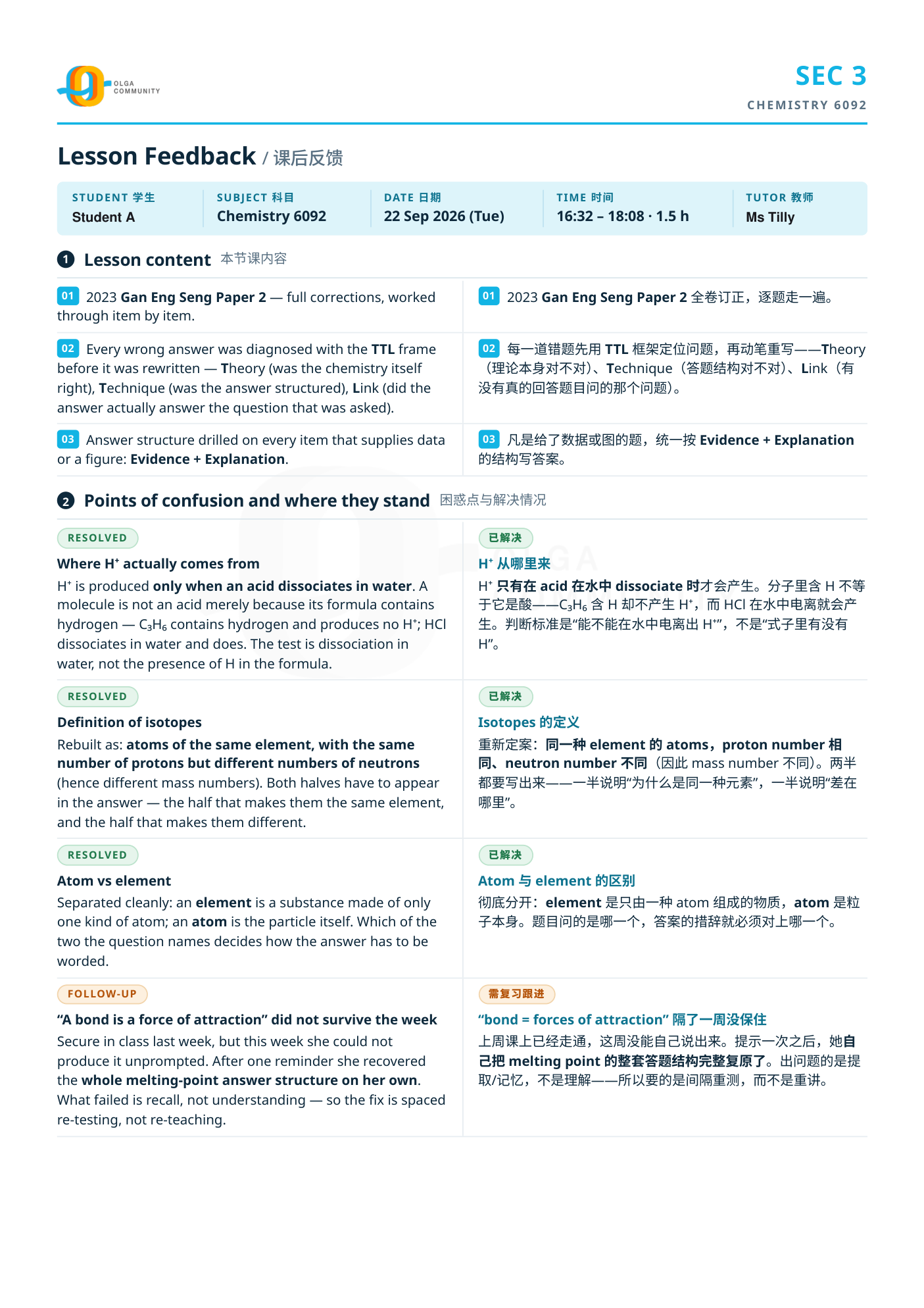
Lesson feedback.
Content covered, points of confusion (resolved or follow-up), learning habits observed, homework and next-lesson focus.
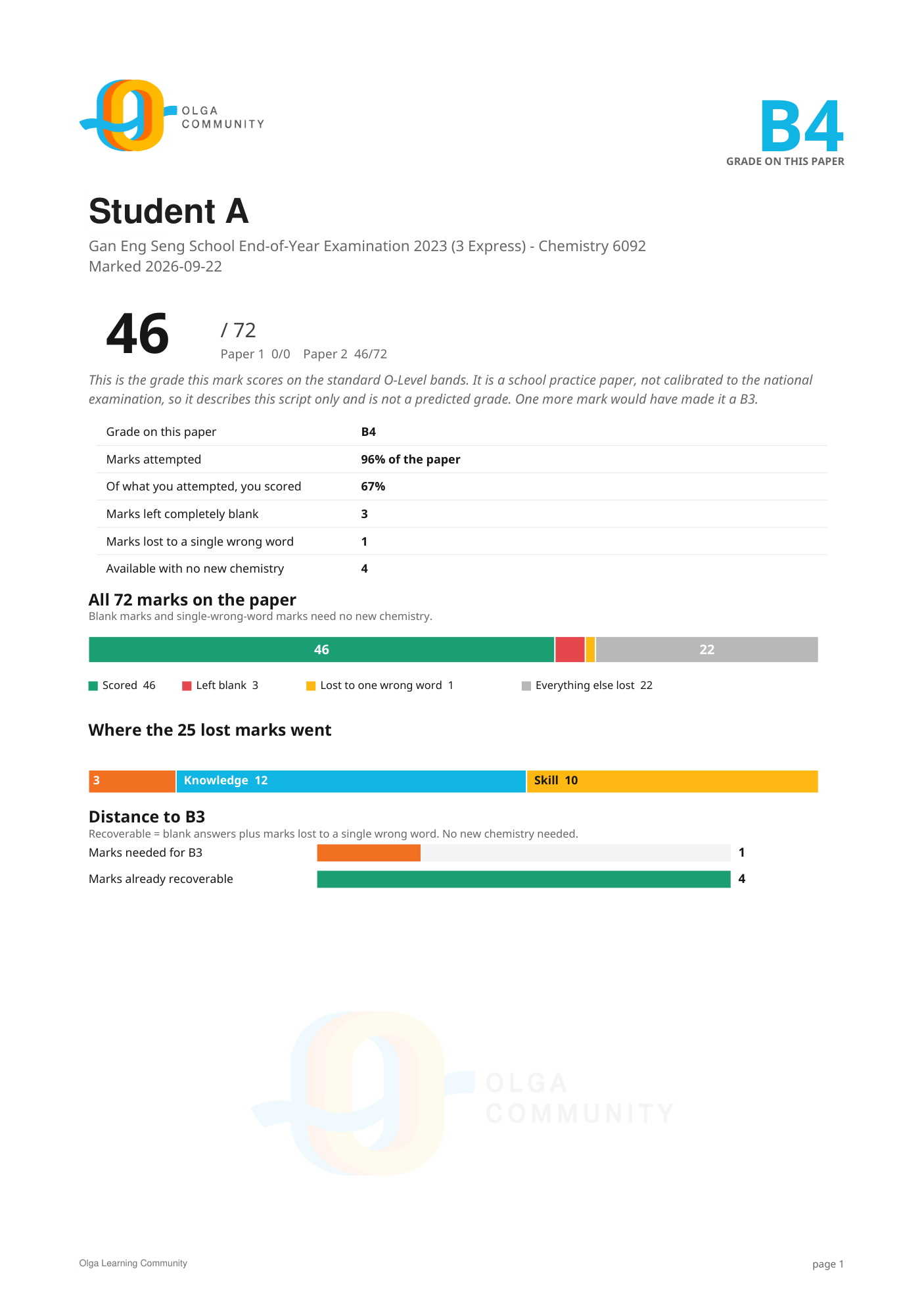
Paper analysis report.
Grade band and marks by section, where marks were lost (knowledge or skill), and a question-by-question diagnosis. Measured against O-Level grade bands and the syllabus, never against classmates.
Technology in our teaching
Olga has its own team of AI engineers building AI education products. Our tutors use them to prepare lessons, analyse marked papers and plan the next step for each student.
Our view is simple: AI and technology can never replace teachers, but they help teachers teach better.
Students are encouraged to question
Every idea is taught as a chain of reasoning, so students can check each step and question it. When a student is right, we say so in front of the class.
Tutors and students also spend time together outside class — badminton, birthdays.